
Separating signal from noise when analyzing your content
When you review content performance in GSC or GA4, the amount of available data can make it difficult to figure out what matters. The raw data isn't very useful but through filtering and data exploration you can hone in on the data that has a measurable impact on success. SEO Gets makes it easy to apply, customize, and save filters for instant access every time you interact with your GSC or GA4 data.
When measuring SEO and content performance in SEO Gets, the fastest way to separate signal from noise is to:
Create topic clusters that focus on core ideas that matter to your business
Build content groups that allow you to analyze related pages or sections of your website to measure and compare performance
Mark "priority" for the topic clusters and content groups that are tied closely to business impact
Below, we'll provide some simple examples of how you can use SEO Gets to focus your SEO reporting and analytics on high-priority pages and concepts that have real, tangible business impact.
One of the classic SEO pitfalls is focusing on growth without context, such as when impressions and clicks are increasing but conversions are flat. By digging below the surface and acknowledging which pages connect to particular points along the buyer's journey or ladder into key ideas that create "aha" moments in your users, you can focus on metrics that matter and abandon a "chart go up" mentality.
Evaluating signal vs noise across key metrics in SEO Gets
The metrics available to you in SEO Gets are only as useful as the context you apply to them — the same number can tell a completely different story depending on which pages you're looking at and what those pages are supposed to do. Here's a breakdown across the core metrics we track in GSC and GA4.
Google Search Console
Clicks are signal when they're coming from pages with strong ICP alignment — bottom-of-funnel content, feature pages, comparison pages, or anything tied to a conversion goal. They become noise when they're driven by broad informational content attracting users who have no realistic path to becoming customers. A spike in clicks that doesn't move pipeline is just flattering data.
Impressions are almost always closer to noise than signal on their own. High impression counts tell you Google is serving your pages — not that the right people are finding them or that anyone is interested enough to click. Impressions become useful signal only when paired with CTR and position data, or when you're tracking visibility loss for pages that matter. Watch for impression decay on high-value pages; ignore impression growth on pages that were never meant to convert.
Average Position is signal when it's tracking keywords directly tied to your ICP or business goals, and noise when it's averaged across your entire keyword footprint. A blended average position metric is one of the most misleading numbers in SEO — it can look like progress while your most important pages are slipping. Always segment by content type or topic cluster before drawing conclusions.
CTR is one of the more honest metrics in GSC because it reflects whether your page is compelling enough to earn the click it's being offered. Low CTR on a high-impression page is signal — it tells you the title or meta description is failing. High CTR on a low-volume keyword is still signal if that keyword belongs to your ICP. CTR becomes noise when you obsess over it on informational content where the query was never going to convert regardless of click volume.
Google Analytics 4
Sessions follow the same logic as clicks — context determines everything. Sessions from your ICP on high-intent pages are signal. Sessions from a viral blog post that attracted the wrong audience are noise dressed up as momentum. The question to ask is always: who are these sessions, and where did they come from?
Engagement Rate is an underrated signal when evaluated on the right pages. High engagement on a bottom-of-funnel page suggests the content is resonating with someone seriously considering your product. Low engagement on a top-of-funnel post might mean nothing at all — the user got what they needed in 20 seconds and left satisfied. Engagement rate becomes noise when applied uniformly across all content types without accounting for what a "successful" visit actually looks like for that page.
Key Events are your cleanest signal in GA4 — provided you've defined them correctly. A key event tied to a demo request, a pricing page visit, a trial signup, or a meaningful scroll depth on a solution page is directly connected to business outcomes. Key events become noise when they're configured around low-intent interactions — newsletter signups from informational posts, PDF downloads that never lead anywhere — that feel meaningful but don't ladder into revenue.
Revenue is pure signal, full stop. It's the metric everything else should ladder into. If your SEO program can't draw a line — even a dotted one — between its activity and revenue, that's worth addressing before you optimize another meta description. Revenue data in GA4 is most powerful when filtered by organic channel and cross-referenced with the content types and topic clusters that drove the session.
High-signal content types
A practical way to separate signal from noise is to ask a simple question for each piece of content you're evaluating: if this page disappeared tomorrow, would it affect revenue, retention, or our ability to compete for the customers we actually want? If the answer is yes, it's signal. If the answer is no — or if you have to think about it for too long — it's noise. Build your prioritization framework around that question and your optimization efforts will start to compound in the right direction.
Signal is a pattern that points to a clear action. The ability to identify what that action is should be apparent when you review your content. Right now, we ascribe signal to goal-oriented content, such as:
Product and feature pages — bottom-of-funnel, high purchase intent, directly tied to revenue. If these decay, pipeline shrinks.
Comparison and alternative pages — "X vs Y" and "best X alternatives" capture evaluation-stage buyers who are actively deciding. One of the highest-converting content types available.
Use case and solution pages — ICP-specific pages that connect your product to a specific problem, industry, or role. Strong for both SEO and sales enablement.
Persona and audience pages — content written for a specific buyer type that speaks directly to their context. Underused and highly effective for qualified traffic.
Integration and compatibility pages — "does X work with Y" queries are exploding as the software stack grows. High intent, low competition on many terms.
Landing pages tied to paid + organic — pages that serve double duty across channels and support conversion goals beyond just rankings.
Retention and onboarding content — help docs, tutorials, and how-to content that keeps existing customers successful. Often ignored in SEO programs but indexed, searched, and valuable for reducing churn.
High-noise content types
Noise is everything that looks interesting but does not change your next move. A one-off wobble, a query that never mattered to the page, or a tiny overlap between URLs can pull you into busywork. This content often looks like:
Broad informational blog posts — high impressions, low relevance to ICP, easy to over-invest in
Trend and news content — short shelf life and rarely attracts your buyer at the right moment
Volume-driven listicles — built to rank, not to convert; monitor but deprioritize in your optimization calendar
Build topic clusters and content groups that prioritize signal or filter out noise
Not all content deserves equal attention, and treating it as if it does is one of the most common ways SEO programs lose focus. The signal you should be chasing is impact — specifically, whether a piece of content is moving someone closer to becoming a customer, retaining an existing one, or directly supporting a measurable business goal.
Content with strong ICP alignment deserves the same level of urgency. A page that consistently attracts your ideal buyer — even at modest traffic volume — is worth more than a high-traffic piece that pulls in a broad, unqualified audience. Volume is easy to chase and hard to convert. When you prioritize content that resonates with the people most likely to buy, you're optimizing for pipeline, not just page views. This is the distinction that separates content programs that drive growth from content programs that just drive reports.
How we built and prioritized our content groups
Here's a direct example of how SEO Gets builds strategic, goal-aligned content groups. Below, you can see that we've both split our site into subfolders and related content based on our reporting needs. We've highlight (and marked as "priority") our feature pages (/feature/), free tools (/tools/), help desk (/help), and homepage (/). Here's why:
Feature Pages - bottom-of-funnel, product-centric pages that address users' specific needs and pain points. Our users come to SEO Gets with a specific job to be done in mind that they need us to solve, and we build features to accomplish that job.
Free Tools - a large portion of our organic audience finds us through the helpful free tools we've built for SEOs. These users are also more likely to convert into subscribers because we have built trust and offered something truly valuable at no cost.
Help Desk - at the time of this writing, our help desk is brand new! We want to track and analyze its performance to ensure that users are not only finding it but engaging with it and finding clear answers to their questions.
Homepage - our homepage is another primary driver of organic traffic and one of the pages with the highest conversion potential. Separating out your homepage is typically a good idea because it allows you to not only track one of your strongest pages but also monitor fluctuations in brand awareness and branded search.
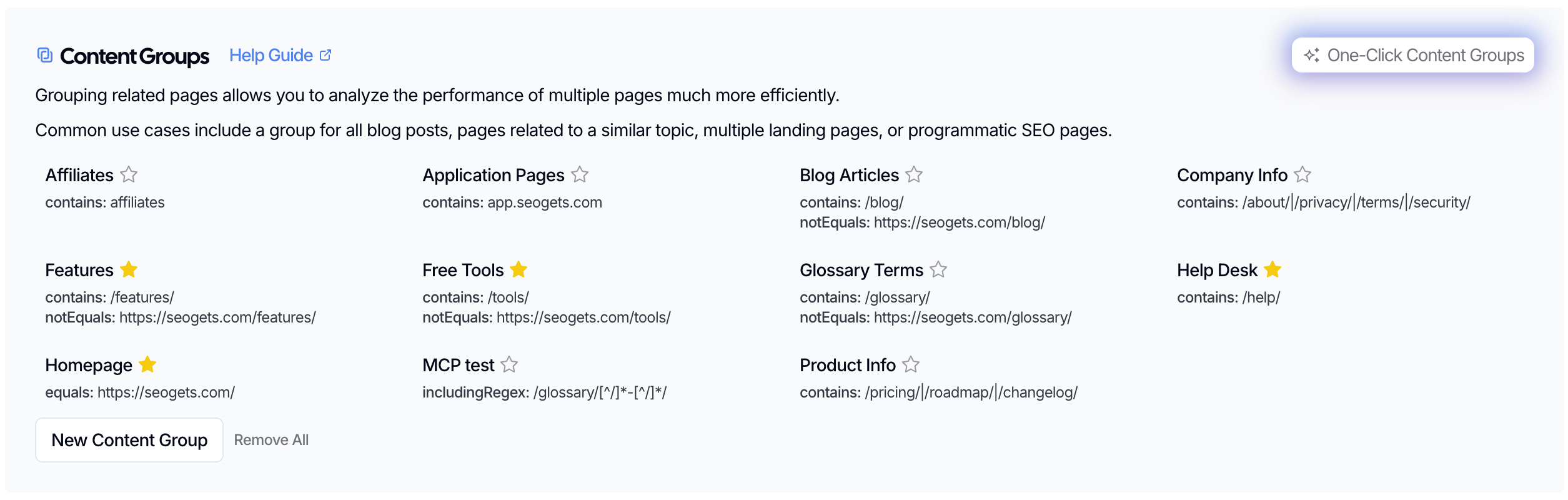
In addition to these "priority" content groups, we also grouped other areas of the website have a less-direct impact on the success of our business. This gives us the ability to filter in and filter out these sections of the website as needed to get a clearer picture of performance.
How we built and prioritized our topic clusters
Topic clusters work in a similar way. We've created keyword-based topic clusters focused on core features that map to our ICPs' jobs to be done (and marked them "priority"). In addition, we created topic clusters that are relevant but lower in our prioritization hierarchy to monitor as well. Each cluster represents an important idea or group of ideas where we want to gain visibility and awareness to attract more subscribers. Both types of clusters share one important characteristic. They're oriented towards specific goals.
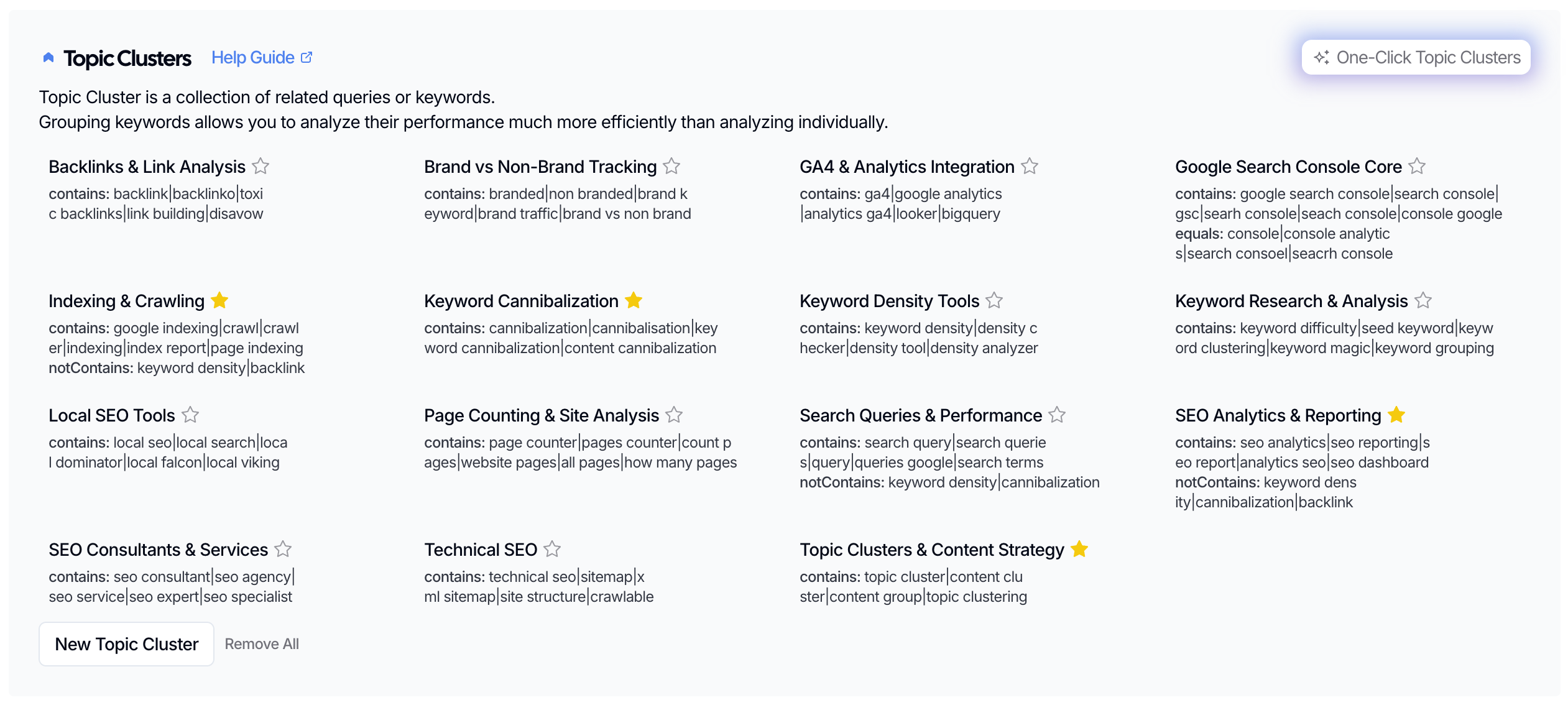
When topic clusters are goal-oriented, the internal linking structure does more than help Google understand your site. It guides real users through a logical progression — from awareness to consideration to decision — and each page reinforces the next. Goal-oriented clusters also make prioritization easier. When performance dips, you know immediately whether the affected pages matter — because every page in the cluster was created with a defined purpose. Contrast that with a broad, theme-based cluster where a rankings drop might affect ten pages, none of which you can directly tie to a business outcome.
What's next?
The SEO programs that compound over time aren't the ones tracking the most data — they're the ones tracking the right data with intention and consistency. By building topic clusters and content groups around specific goals, marking your highest-impact pages as priority, and applying the signal-versus-noise filter every time you review performance, you give every optimization decision a clear reason to exist. That clarity is what turns a busy SEO program into a productive one.